

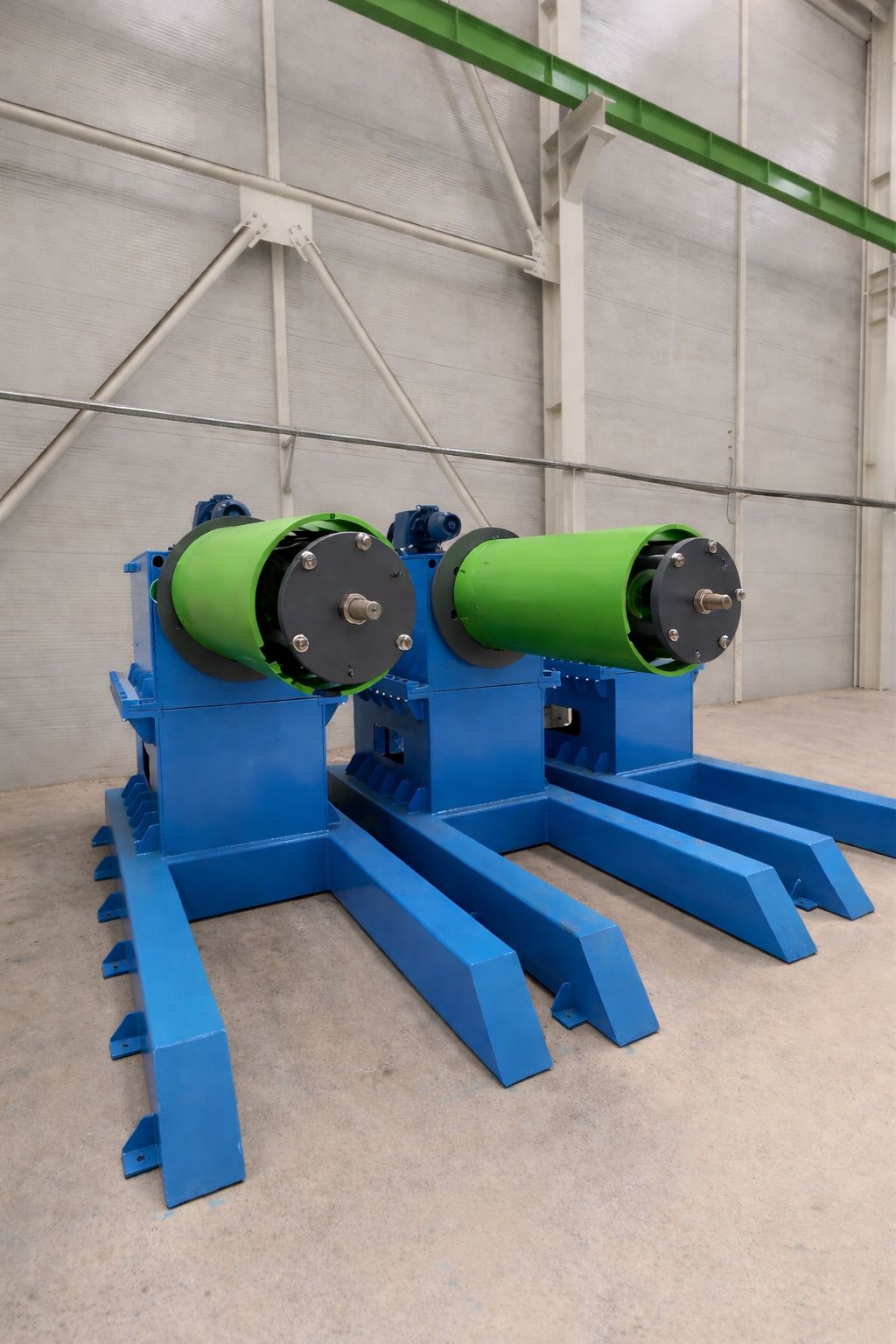
The Role of the Decoiler Unit in Sandwich Panel Production Lines
In a sandwich panel production line, many investors focus on the double belt press, chemical dosing system, or roll forming stations. However, one of the most critical units that directly affects panel surface quality and line stability is often underestimated — the decoiler unit.
The decoiler is the starting point of the entire production process. Any instability, vibration, or misalignment at this stage will continue throughout the line and negatively affect the final panel quality.
For this reason, a well-engineered decoiler system is essential for reliable and continuous sandwich panel manufacturing.
What Is a Decoiler Unit?
A decoiler is a mechanical unit designed to hold and unwind heavy steel coils in a controlled and synchronized manner. These steel sheets are then fed smoothly into the roll forming machine.
In sandwich panel production, steel coils can weigh several tons. Managing this weight with precision requires strong mechanical structure and precise control systems.
Why the Decoiler Directly Affects Panel Quality
Many people assume that panel quality starts at the roll forming section. In reality, it starts at the decoiler.
If the sheet feeding is not stable:
- Sheet tension fluctuates
- Surface scratches may occur
- Sheet alignment shifts
- Roll forming precision decreases
- Panel geometry becomes inconsistent
A poor decoiler causes problems that cannot be corrected later in the line.
Key Features of a High-Quality Decoiler System
A reliable decoiler for sandwich panel lines should include:
- Heavy-duty coil carrying capacity
- Hydraulic expansion mandrel system
- Motorized and synchronized feeding
- Tension control system
- Smooth rotation without vibration
- Safety braking system
These features ensure the sheet enters the line perfectly aligned and tension-balanced.
Hydraulic vs. Mechanical Decoilers
Hydraulic decoilers provide better grip and stability for heavy coils. They allow precise expansion of the mandrel and safer coil loading.
Mechanical decoilers are simpler but may not provide the same level of stability required for high-speed sandwich panel lines.
For continuous industrial production, hydraulic decoilers are the preferred choice.
The Importance of Tension Control
Tension control is one of the most overlooked aspects of decoiler performance.
Proper tension control:
- Prevents sheet waviness
- Protects sheet surface coating
- Maintains roll forming accuracy
- Improves panel surface appearance
Without tension control, even the best roll forming machine cannot perform properly.
Synchronization with the Roll Forming Line
The decoiler must work in perfect synchronization with the roll forming unit. Sudden feeding or stopping causes sheet stress and alignment issues.
Modern sandwich panel lines use automated control systems to synchronize decoiler speed with the rest of the line.
Safety and Operational Efficiency
Handling multi-ton steel coils is a serious safety matter. A well-designed decoiler includes:
- Automatic braking systems
- Easy coil loading mechanism
- Operator safety protections
- Stable base structure
This not only improves safety but also reduces setup time and labor effort.
Conclusion
The decoiler unit is not just a coil holder. It is the foundation of panel quality and line stability in sandwich panel production.
Investing in a high-quality decoiler system means investing in better panel surface quality, smoother production flow, and fewer operational problems throughout the line.
Understanding the importance of this unit helps factory owners make smarter decisions when choosing a sandwich panel production line.