

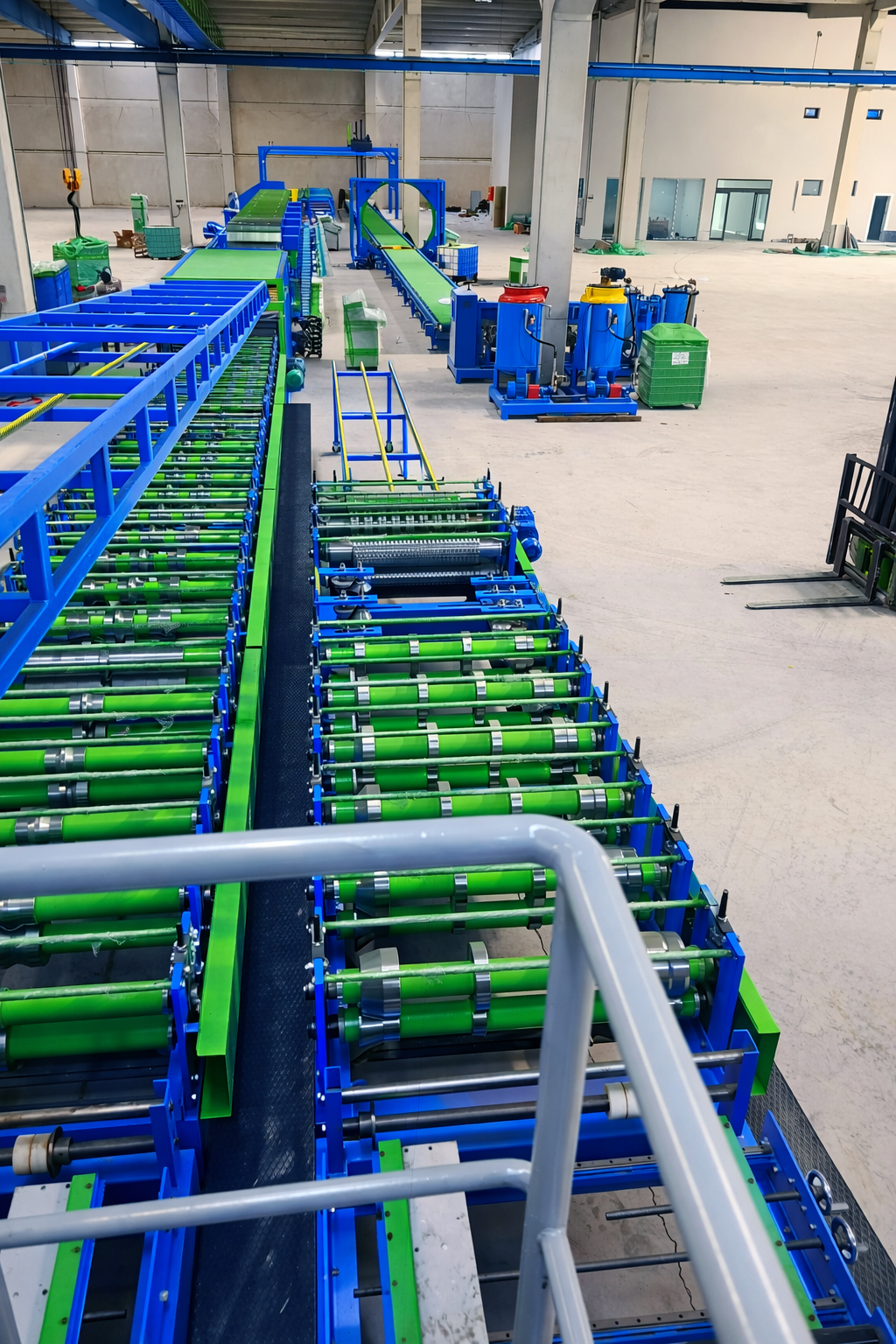
The roll forming unit is not just a shaping system—it is the core engineering component that defines production quality. Panel geometry, surface finish, and structural strength all depend on its performance.
Working Principle of Roll Forming
Roll forming is a continuous process where sheet metal passes through multiple roller stations and is gradually shaped.
- Balanced material stress distribution
- Reduced surface defects
- High dimensional accuracy
Key Engineering Parameters
1. Roll Tooling Design
- Profile-specific roller geometry
- Gradual deformation planning
- Controlled material flow
2. Number of Stations
- More stations = higher precision
- But increased cost and line length
3. Line Speed and Synchronization
- High speed increases capacity
- Requires advanced automation control
Siemens Automation for Precision
- SIMATIC S7-1500 PLC for synchronization
- SINAMICS drives for speed & torque control
- Encoder-based positioning
- Full integration via TIA Portal
Quality Impact
Roll forming affects:
- Panel geometry
- Surface quality
- Joint compatibility
- Structural strength
Common Problems & Solutions
- Wave effect → Roller optimization
- Edge cracking → Gradual forming
- Dimensional errors → Servo synchronization
Industry 4.0 Integration
- Data analytics
- Predictive maintenance
- Remote monitoring
- Smart production systems
Conclusion
A well-designed roll forming unit combined with Siemens automation ensures high precision, efficiency, and long-term production stability.