

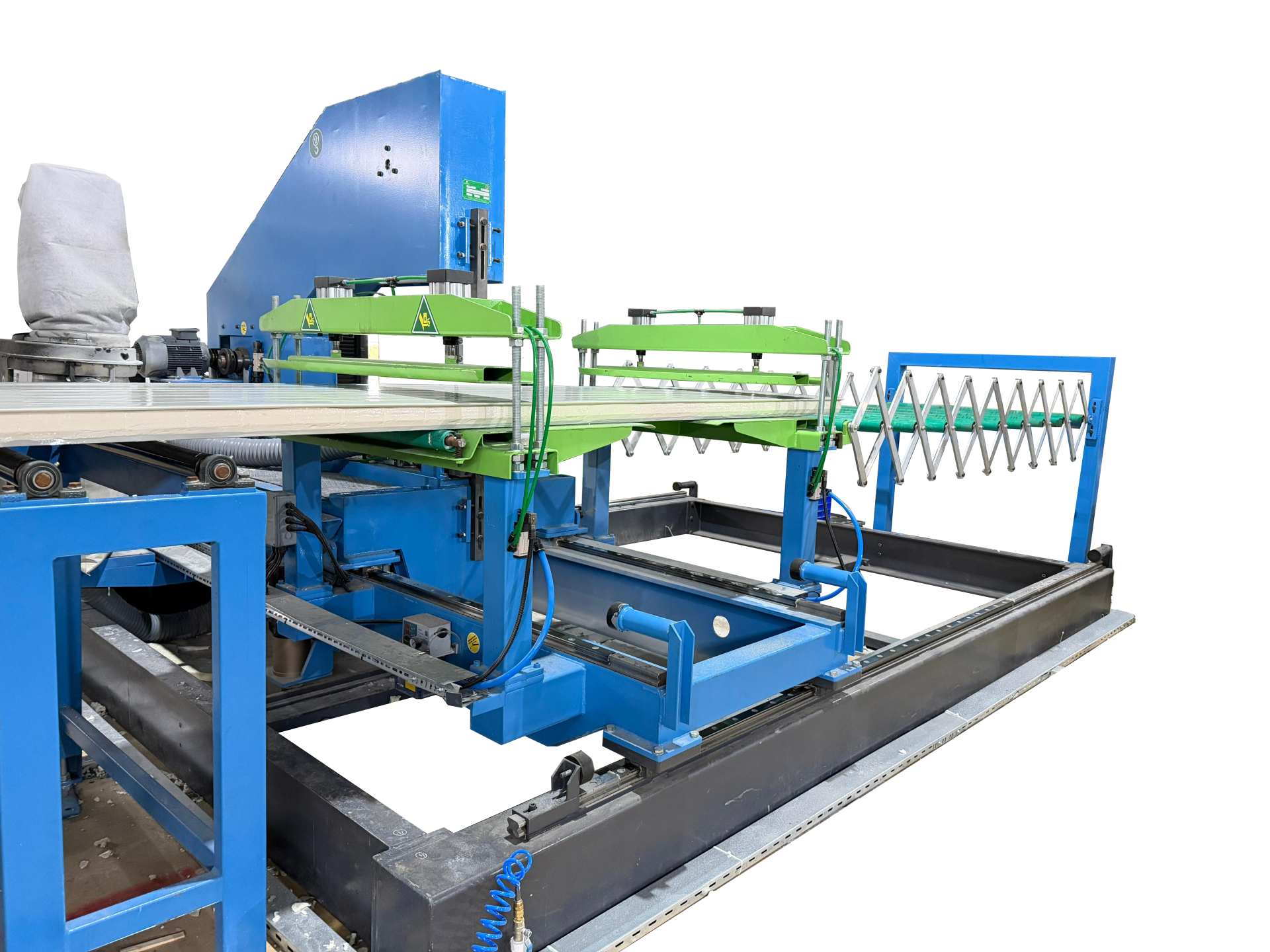
The flying saw unit is one of the most important components in sandwich panel production lines for cutting panels to the desired lengths. This system allows panels to be cut without stopping the production line, increasing efficiency and maintaining high dimensional accuracy.
Modern flying saw systems used in sandwich panel production lines operate with high-precision servo motors and PLC-controlled automation systems.
Function of the Flying Saw Unit
The flying saw unit:
Cuts panels to the required length
Moves synchronously with the production line speed
Performs cutting without stopping the line
This ensures continuous production and higher output capacity.
How the Flying Saw System Works
The flying saw system performs cutting by moving synchronously with the production line.
The process works as follows:
Panel length is measured by sensors
The PLC determines the cutting position
The saw carriage accelerates to match the line speed
The saw cuts the panel
After cutting, the unit returns to its starting position
This entire process occurs within seconds.
Advantages of Flying Saw Systems
Continuous Production
Cutting without stopping the line increases production efficiency.
High Cutting Precision
Servo-controlled systems provide millimeter-level cutting accuracy.
Reduced Material Waste
Accurate cutting minimizes scrap and material loss.
Compatibility with High Line Speeds
Modern flying saw systems can operate efficiently even at high production speeds.
Technologies Used in Flying Saw Units
Modern flying saw units typically include:
Servo motor driven movement systems
PLC based automation control
Linear guide rail systems
Automatic length measurement sensors
High-power industrial saw motors
These technologies ensure fast, reliable, and precise cutting operations.